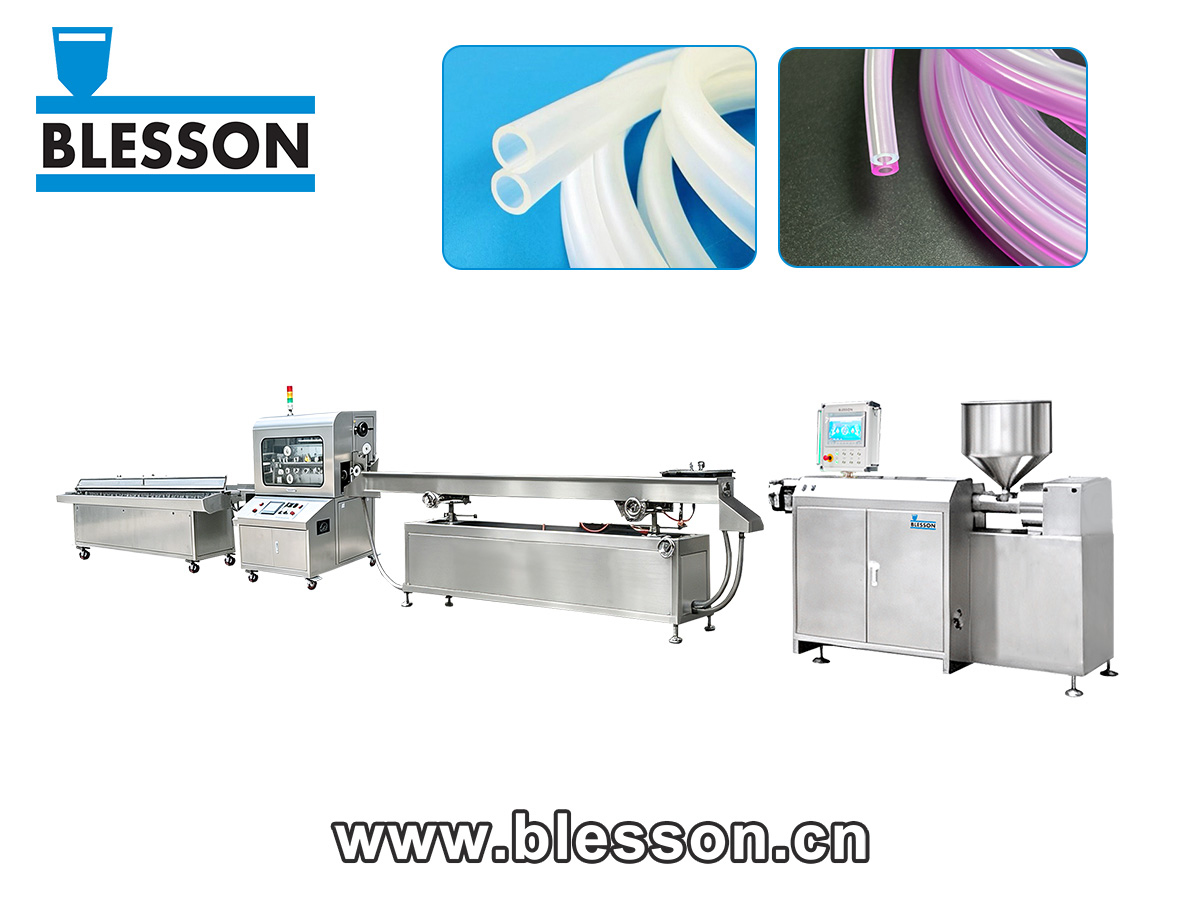
The entire machine uses SEW servo motors and a Siemens PLC control system as the control core. Closed-loop synchronous speed regulation is adopted in the extrusion and haul-off sections to ensure real-time matching and dynamic compensation among screw speed, haul-off line speed, and tube extrusion output, thereby eliminating diameter deviation caused by speed fluctuations from the power source. In the cooling and sizing section, a sealed vacuum cooling system is used, enabling the tube blank to quickly and uniformly complete dimensional locking after entering the sizing stage, effectively ensuring dimensional uniformity and batch-to-batch consistency of fine tubes during continuous production.
一. Product Overview of the Blesson PVC Medical Double-Row Tube Extrusion Line
The PVC medical double-row tube is a dual-channel fluid transfer hose designed specifically for medical scenarios. The two tubes are formed integrally side by side, with the media channels physically isolated from each other. Its core purpose is to achieve independent and simultaneous delivery of two drugs or fluids, pneumatic connections for equipment, and distribution of multiple signals and media, thereby fundamentally avoiding cross-reactions and compatibility interference between different fluids. في نفس الوقت, it consolidates transfer tasks that would otherwise require multiple tubes into a single tube body, improving clinical operational efficiency.
In terms of material, the product uses medical-grade PVC, which combines soft elasticity, kink resistance, tear resistance, and good chemical stability. It can withstand common disinfectants and body fluid environments and is suitable for single-use or short-term indwelling applications. The integral double-row structure prevents the tubing from tangling or shifting, ensures neat routing, and facilitates fixation and threading operations. On this basis, the product can be integrated with functional elements such as radiopaque lines and graduation markings as required. Combined with color differentiation design, the purpose of the tubing can be identified at a glance in fast-paced clinical environments, further reducing the risk of misconnection.
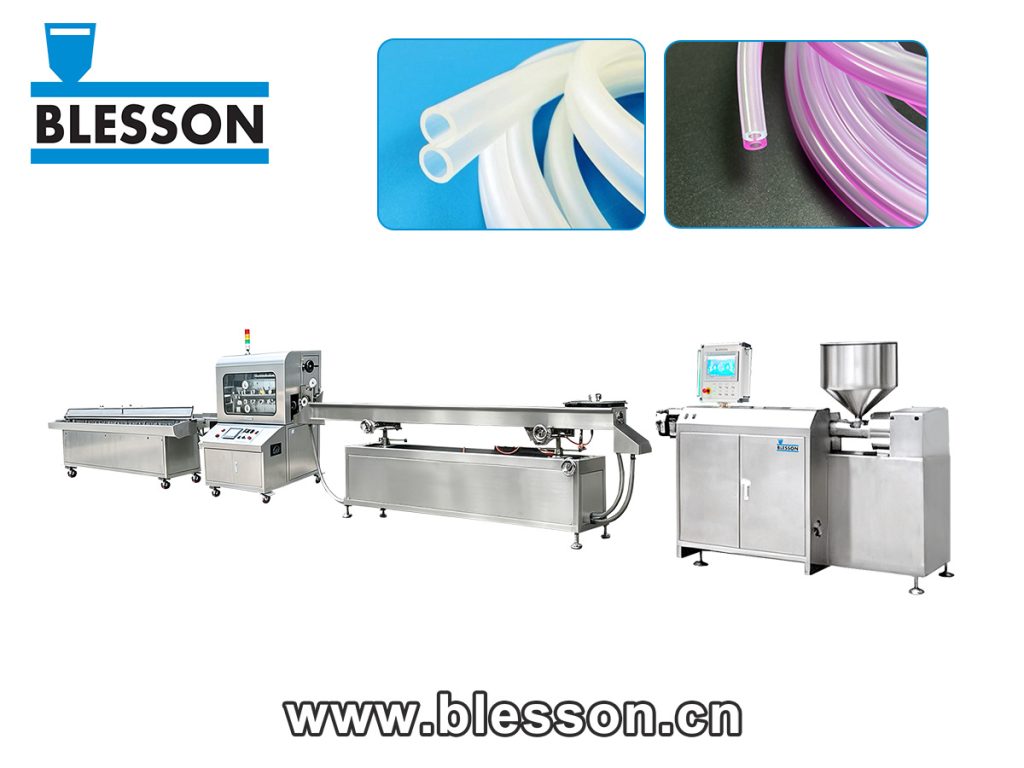
Blesson PVC Medical Double-Row Tube Extrusion Line
Application Scope of PVC Medical Double-Row Tubes
Based on the structural characteristics of independent dual-channel transmission, PVC medical double-row tubes cover multi-level clinical needs ranging from routine infusion to specialty intervention:
1.Intensive care and venous access: The main channel is used for rapid fluid resuscitation, blood transfusion, or infusion of high-flow fluids such as parenteral nutrition, while the auxiliary channel simultaneously provides precise administration of vasoactive drugs, antibiotics, and other medications, reducing the risks associated with repeated puncture and drug exposure.
2.Surgical irrigation and drainage:The large-diameter channel is connected to negative-pressure suction to drain effusion, pus, or bloody exudate; the small-diameter channel continuously infuses irrigation fluid or local medication, enabling simultaneous irrigation and suction, reducing the probability of blockage and infection. It is suitable for abdominal, orthopedic, and laparoscopic surgical scenarios.
3.Gastroenterology and gastrointestinal management:The main channel is used for gastrointestinal decompression, while the auxiliary channel is used to infuse prokinetic drugs or enteral nutrition, allowing decompression and treatment to be performed simultaneously.
4.Respiratory and anesthesiology:As ancillary tubing for anesthesia machines or respiratory equipment, the main channel delivers anesthetic gas or ensures ventilation, while the auxiliary channel is used for pressure monitoring, drug nebulization, or emergency oxygen supply.
5.Specialty intervention and equipment integration: Delivery–recovery circuits for dental and medical aesthetic equipment, as well as accommodating guidewires, injecting contrast agents, or performing pressure monitoring during interventional procedures, can all be accomplished through the dual-channel structure of the double-row tube.
二. Overview of the Blesson PVC Medical Double-Row Tube Extrusion Line
(1) Core Configuration of the Production Line
The entire machine uses SEW servo motors and a Siemens PLC control system as the control core. Closed-loop synchronous speed regulation is adopted in the extrusion and haul-off sections to ensure real-time matching and dynamic compensation among screw speed, haul-off line speed, and tube extrusion output, thereby eliminating diameter deviation caused by speed fluctuations from the power source. In the cooling and sizing section, a sealed vacuum cooling system is used, enabling the tube blank to quickly and uniformly complete dimensional locking after entering the sizing stage, effectively ensuring dimensional uniformity and batch-to-batch consistency of fine tubes during continuous production.
At the forming station, the production line adopts dual die heads or co-extrusion technology to simultaneously produce two parallel tubes. The inner diameter, سمك الجدار, and radiopaque line position of the two channels can be precisely adjusted separately. This configuration is the physical basis for achieving “one-inlet/one-outlet” flow paths that do not interfere with each other and have clear flow direction—the two tubes are formed under the same production cycle while each maintains independent channel dimensions and functional positioning.
(2) Overall Advantages of the Blesson PVC Medical Double-Row Tube Extrusion Line
1.Systematic assurance of dimensional accuracy and stability for fine tubes. Closed-loop synchronous speed regulation minimizes the coordination error between extrusion and haul-off, while sealed vacuum cooling further eliminates ovality and wall-thickness drift caused by uneven cooling. Together, these features enable the production line to maintain dimensional uniformity of fine-diameter tubing during long-term continuous operation.
2.Independent controllability of dual-channel functional parameters. The dual-die-head/co-extrusion architecture allows the inner diameter, سمك الجدار, and radiopaque line orientation of the two tubes to be set separately. This means that a single double-row tube can simultaneously carry a “high-flow main channel” and a “fine auxiliary channel,” or be configured with radiopaque markings of different colors, meeting clinical requirements for both flow classification and visual distinction.
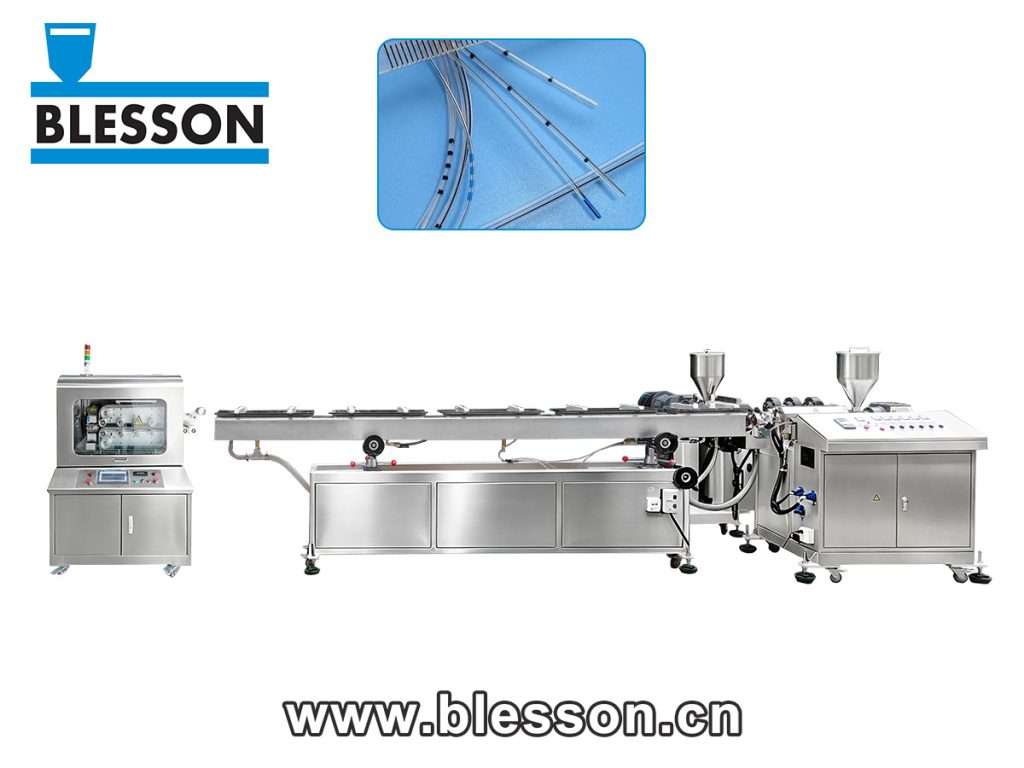
3.Flexible switching of product configurations on the same production line. By simply adding an extruder and changing the corresponding die, the line can switch from a single-color double-row tube without radiopaque lines to a single-color double-row tube with radiopaque lines or a dual-color double-row tube with radiopaque lines, without rebuilding the entire production line. This design enables the line to provide flexible response capability covering multi-specification and multi-configuration orders while maintaining medical-grade clean and low-noise operation.
4.Data foundation for quality traceability. Production parameters can be stored long-term in the PLC system. Key process data for each batch, such as speed curves, temperature settings, and cooling conditions, can be traced back, providing a complete parameter basis for quality release and deviation investigation in cleanroom batch production environments, and aligning with the process traceability requirements of medical device manufacturing regulations.
(3) Blesson Customized Services
On the basis of the standardized production capabilities described above, Blesson can provide customers with customized solutions ranging from tube structure to functional configuration. The customization scope covers: inner diameter and wall thickness combinations of the two channels, single-color or dual-color schemes, the presence or absence of radiopaque lines and the number and position distribution of colored lines, tube length and connection method, and whether graduation markings need to be integrated on the tube wall or specific connector adaptation is required. For scenarios with special routing or installation requirements, Blesson can also jointly confirm design solutions with customers regarding the form of the connection between the two tubes (tearable or non-tearable).
The customization process starts from drawings or physical samples provided by the customer. Through die adjustment and extrusion parameter matching, it completes the transformation from structural design to mass production, so that the final product, while maintaining the core function of independent dual-channel transmission, fits specific equipment interfaces and clinical operating habits.